Penguins in the Cape Peninsula
The Cape Peninsula is one of the few places on Earth where wild penguins live within commuting distance of a major city. No boat required, no island transfer — just a 45-minute drive south from Cape Town and a short walk. Most travelers know about Boulders Beach. Fewer know there is a second colony equally large, dramatically quieter, and cheaper to enter.
Two Penguin Colonies on the Cape Peninsula — and Why Both Exist
Two accessible African penguin colonies sit on the Cape Peninsula: Boulders Beach in Simon’s Town and Stony Point Nature Reserve in Betty’s Bay. Both hold breeding populations of roughly 2,500 birds. The experience of visiting each one is not remotely similar.
| Feature | Boulders Beach (SANParks) | Stony Point (CapeNature) |
|---|---|---|
| Entry — international adult | R222 | R80 |
| Entry — SA resident adult | R85 | R50 |
| Entry — international child under 12 | R111 | R40 |
| Colony size (approx.) | ~2,500 birds | ~2,500 birds |
| Typical crowd level | High Dec–Jan; moderate otherwise | Low year-round |
| Swimming beach nearby | Yes — adjacent, free entry | No |
| Drive from Cape Town CBD | 45–60 min | 80–100 min |
| Reachable without a car | Yes — Metrorail to Simon’s Town | Car only |
| Managed by | SANParks / Table Mountain NP | CapeNature |
Boulders Beach: What the Entry Fee Gets You
Boulders Beach is part of Table Mountain National Park, managed by SANParks. The colony started with just two breeding pairs in 1982. Today it holds roughly 2,500 birds — a story of unexpected recovery in an otherwise declining species, all within the town limits of Simon’s Town.
Entry comes through two boardwalk sections. The Boulders Viewpoint offers an elevated overview of the colony. Foxy Beach is the better option by some distance — you walk at ground level, 3–4 meters from penguins nesting under granite boulders and low coastal scrub. During breeding season, fluffy chicks sit at burrow entrances while adults come and go from the water. The proximity feels unreal until you’re standing there.
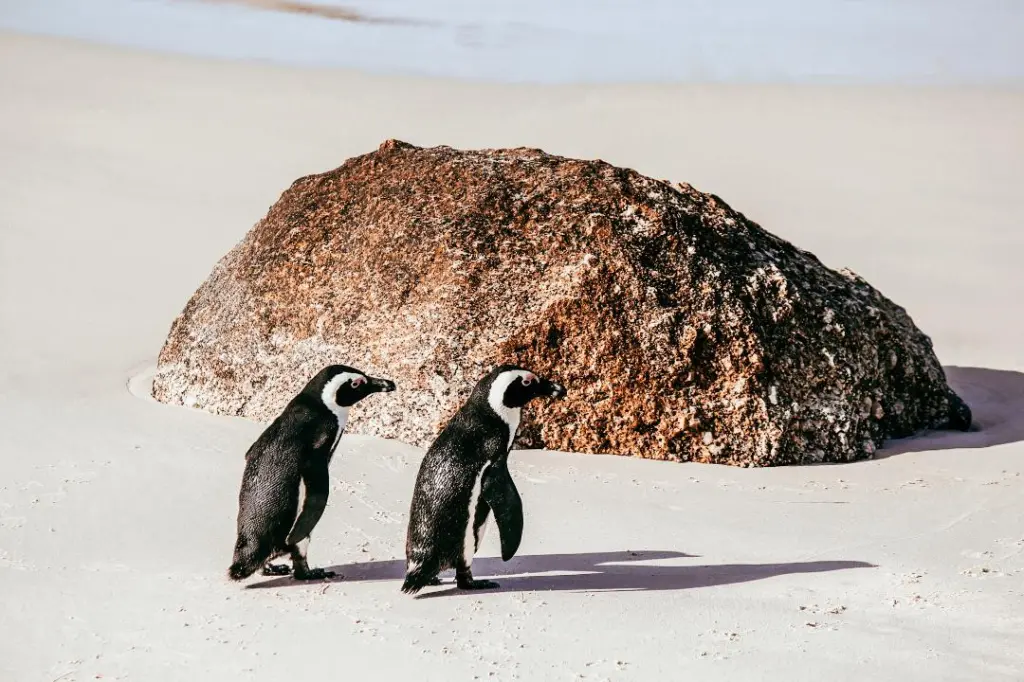
The swimming beach adjacent to the penguin colony is free to access and separate from the paid boardwalk. Penguins wander through it routinely — resting on the sand, surfing in the shallows, occasionally walking close to swimmers without any sign of concern. This is where those images that look staged actually happen. Give birds at least a meter of space. African penguins bite when cornered, and the warning signs posted everywhere are not decorative.
Simon’s Town is a 15-minute walk north along the main road. Cafes and restaurants cluster near the train station, making a half-day stop easy to build around the visit.
Stony Point: The Colony Most Cape Peninsula Tours Skip
Stony Point Nature Reserve sits in Betty’s Bay, managed by CapeNature. It rarely appears on standard Peninsula itineraries because it falls roughly 20 minutes past the point where most tours turn around. That absence is exactly the reason to go.
The boardwalk at Stony Point winds through coastal fynbos across uneven granite slabs right alongside active nesting areas. Penguins nest within a meter of the path in several places. On a weekday outside school holidays, you can walk long stretches of the boardwalk without passing another tourist. The birds are as habituated to people as those at Boulders — they simply have far fewer people to be habituated to.
Entry is R80 for international adults, R50 for SA residents. The Harold Porter National Botanical Garden shares the same parking area — R100 to enter, excellent fynbos and birdwatching, a cafe on site. Combining both stops takes roughly three hours and requires no backtracking.
The clear call: if you have a car and want the more immersive, quieter visit, Stony Point is the better colony. If you are traveling without a car or combining the visit with Cape Point or Simon’s Town, Boulders Beach is the logical choice and still genuinely worth the trip.
When to Visit: What Changes by Season and Time of Day
Spheniscus demersus breeds year-round on the Cape Peninsula, which means no month leaves the colonies empty or inactive. But what you observe shifts considerably depending on when you arrive.
October to January: Breeding Peak and Visible Chicks
Nesting activity peaks from October to December. Eggs hatch from November onward and chicks remain near the nest for two to four months before moulting into juvenile plumage. During December and January, grey-brown chicks cluster at burrow entrances across both colonies while adult birds shuttle between the nest site and feeding grounds offshore. Watching a parent return from sea and feed a chick is one of the more compelling sequences available from the boardwalk.
This window overlaps directly with Cape Town’s summer holiday season. Boulders Beach gets genuinely busy. Weekend crowds between 11am and 2pm in December can make the boardwalk feel congested — not dangerous, but enough to affect the experience. Stony Point sees a moderate increase in holiday visitors but stays manageable throughout. At Boulders specifically, arriving before 9:30am in December or January changes things meaningfully: shorter entry queues, more active birds, fewer people between you and the nesting areas.
February to April: Crowd Drop, Moult Begins
School holidays end in mid-January and crowds thin fast. February sees chicks from the October–November nesting still visible, many in mid-transition from grey down to juvenile plumage — a patchy, awkward look that is oddly captivating to watch. Adult birds begin their annual moult through late summer: a two-to-three-week process where they shed and regrow feathers rapidly, fasting ashore the entire time. Moulting birds move slowly and look rough. Biologically interesting, not the most photogenic phase of the calendar.
February is the practical sweet spot for most visitors — warm enough for the swimming beach at Boulders, small enough crowds to make early-morning visits feel relaxed, and chicks still present across many nests.
May to September: Quiet, Weather-Dependent, Underrated
African penguins are non-migratory. Both colonies stay fully populated through winter, and Cape Town’s winter light on a clear morning — low and flat — is exceptional for photography. Stony Point between June and August with no other visitors on the boardwalk offers something difficult to find at most wildlife sites: actual solitude around wild animals that are completely relaxed in your presence.
Winter weather is unpredictable. Northwest storms can turn a clear morning grey within an hour. Check the forecast the night before and go early if the window looks good rather than waiting to see how the day develops.
One rule applies regardless of season: arrive before 10am. Penguins are most active in early morning as they return from overnight feeding at sea. By 11am, especially in summer, many birds are resting in burrows or sheltering in shade. The behaviors worth seeing — preening, courtship, chick feeding, entry and exit from the water — concentrate heavily in the first two hours after sunrise.
The Honest Take on Boulders Beach at Peak Season
Go anyway. Even in December. Even with the crowds.
Boulders Beach during school holidays requires some adjustment. The parking lot fills by 10am on a summer weekend. The boardwalk moves with a loose stream of visitors — you are not walking alone, not stopping wherever you want, and will occasionally stand next to someone who has decided the penguins need to hear them make penguin sounds. Tour groups arrive on a fixed schedule that has nothing to do with what the penguins are doing. A fair proportion of the crowd is there for a photo rather than a wildlife encounter.
None of this changes what you are actually looking at. African penguins at Boulders are deeply habituated to human presence. A nesting bird parked directly below the boardwalk railing at Foxy Beach will sit there while twenty people photograph it from two meters away without moving. A penguin on the swimming beach will walk within arm’s reach of a standing person and show no interest whatsoever. That kind of proximity — to a wild, endangered seabird in its natural habitat — is what makes the visit hold up regardless of who is standing behind you.
For the best version of Boulders Beach: spend 20–30 minutes at Foxy Beach first, where nesting density is highest and birds are most active. Then walk through to the open swimming beach and give it another 15 minutes watching birds move between water and shore. A total visit of 45–60 minutes is usually enough. The single most effective thing you can do to improve the experience is arrive by 9am.
Tip: Boulders Beach and Cape Point sit at opposite ends of the same peninsula road. If you are combining both in one day, drive to Cape Point first — it opens at 7am and crowds build fast after 10am. You will reach Boulders on the way back in the late morning rather than the early afternoon, which is a meaningful difference on a busy December weekend.
Getting to the Colonies: What Each Option Actually Costs
Neither colony is a short detour. Plan each as a dedicated half-day or combine with other stops along the same route.
Boulders Beach by Metrorail and Taxi
The Metrorail Southern Line runs from Cape Town Station to Simon’s Town — a coastal ride of roughly 70 minutes. Trains run approximately every 30–60 minutes depending on time of day. From Simon’s Town station, Boulders Beach is a 15-minute walk or a short taxi ride costing around R50–R80. The route is scenic and sidesteps all parking problems. Check current Metrorail service reliability before depending on it for a timed itinerary — disruptions occur, and a missed return train can significantly affect your plans for the rest of the day.
Boulders Beach by Car
Take the M3 south from the city, then follow the M4 coastal road into Simon’s Town. Total distance from Cape Town city centre: roughly 40km. Paid parking near the entrance runs around R30–R40 for a few hours. On December and January weekends, this parking area fills by 9am. Street parking along the main road in Simon’s Town is usually available and requires a 10–15 minute walk to the penguin entrance.
Stony Point: Car Required
No public transport serves Betty’s Bay. The R44 coastal road from Kleinmond through Betty’s Bay is one of the more scenic drives in the Western Cape — Kogelberg mountains on one side, Atlantic on the other. Allow 90 minutes from Cape Town. Parking at Stony Point is free. Pairing the visit with the Harold Porter National Botanical Garden next door creates a natural half-day itinerary with no backtracking required.
Organized Cape Peninsula Day Tours
Multiple operators in Cape Town run full-day Peninsula circuits that include Boulders Beach, Cape Point, and Chapman’s Peak. Typical pricing runs R600–R900 per person, usually inclusive of transport and entry fees. These tours cover a lot of ground efficiently and make sense if you want to see multiple Peninsula highlights without driving yourself. The consistent downside: most group tours arrive at Boulders Beach between 11am and 1pm, which is the worst possible window for active penguins and the busiest period on the boardwalk. Before booking any Peninsula tour, ask explicitly what time the itinerary reaches Boulders. Any arrival before 10am is workable. After noon in summer, you are paying for the convenience of not driving, not for the best penguin viewing conditions.
The Species You Are Watching Is Disappearing
Spheniscus demersus has lost more than 70% of its global population since 2000. The IUCN Red List classifies it as Endangered, with commercial overfishing of anchovy and sardine — the birds’ primary prey — cited as the dominant cause. Entry revenue at both SANParks Boulders and CapeNature Stony Point funds active colony monitoring, nest box installation programs, and oiled-bird rehabilitation. The colonies you are visiting are among the last stable breeding populations remaining on the African continent.